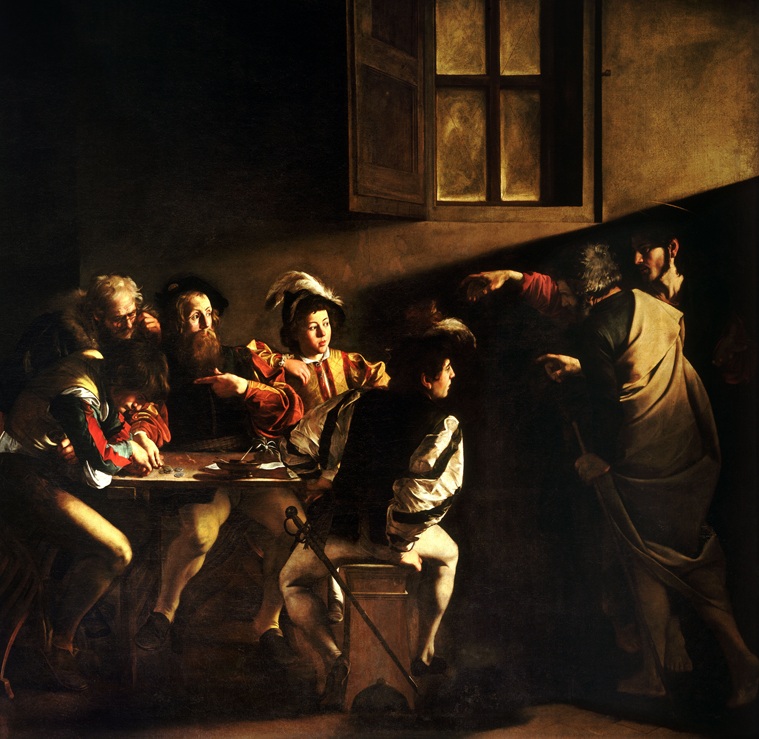
Caravaggio stages a revelation with two tools: a single beam of light and a borrowed gesture. In a tavern-like room, taxmen count coins when Christ steps in from the right with Saint Peter. He doesn’t shout; he points. The light follows that finger and lands on a startled face. Conversion, Caravaggio tells us, is a choreography of light and recognition.
Composition: a rectangle split by radiance
The room is a dark box. A sharp diagonal of light slices from Christ’s hand across the table, picking out heads like candles catching wicks. The figures cluster in two groups: Christ and Peter at the threshold; the money men around the table, bodies leaning in different tempos of disbelief. The geometry is simple, almost theatrical, so that the looking becomes the subject. For a fast method to read such staging, keep our 7-step guide handy.
The finger that quotes Michelangelo
Christ’s outstretched hand echoes Adam’s in Michelangelo’s Creation—but reversed. Instead of life given to man, man is called to a new life. This borrowed contour is Caravaggio’s wit: a Renaissance gesture reframed in a Roman backroom. If you’d like to decode such visual quotations, browse the Glossary of Art Techniques under gesture and quotation.
Street clothes, sacred drama
Fashion is a clue. The velvet doublets and feathered caps are contemporary to Caravaggio, not biblical. That anachronism pulls the story into the viewer’s world—God walks in now. The coins glitter, but Caravaggio keeps the room bare: no ornament to distract from the instant of awakening.
Light as verdict
This is tenebrism with purpose. The beam does more than model form; it makes choices. It spares one face and lets another sink. Matthew’s hand even mirrors the money pile—counting interrupted by calling. Want to practice spotting these cues? Our How to Read a Painting guide pairs well with Caravaggio.
Where to see it
Still in situ at the Contarelli Chapel, San Luigi dei Francesi, Rome—free to visit. For more sources of legal images, explore Open‑Access Museums, and for more Baroque drama, dip into the Baroque archive.
Caravaggio makes the sacred feel like a gasp in a side street: light enters, a finger points, and the world tilts.
Which Caravaggio moment should we step into next?