
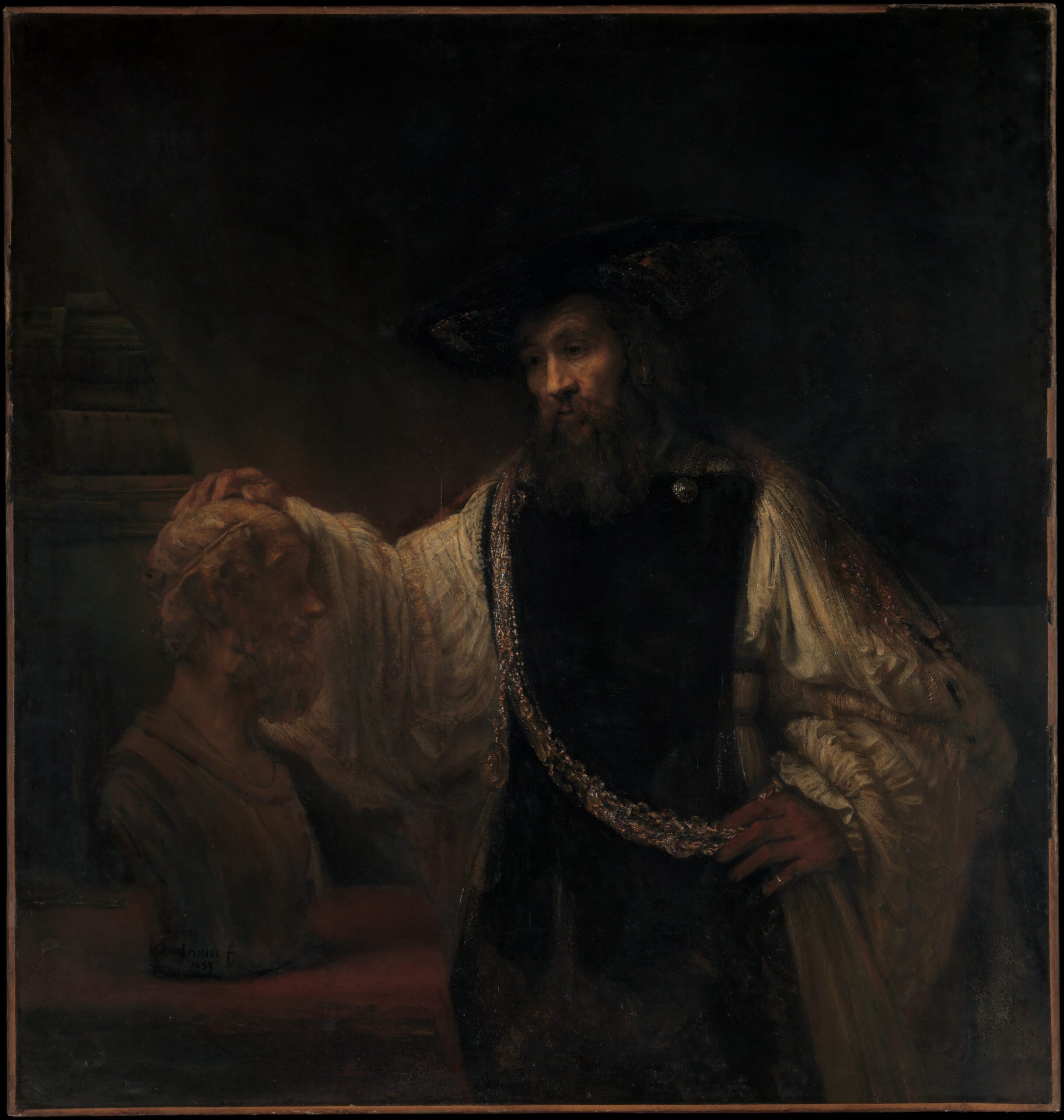
Looking Closer: the gold chain that won’t sit quietly
In Rembrandt’s Aristotle with a Bust of Homer, the loudest voice is not the philosopher’s mind but a gleam of metal. The gold chain and medallion, heavy enough to tug the fabric, anchor the painting’s argument: what weighs more—honor bestowed by patrons, or the inner, Homeric measure of virtue?
Look at how the chain catches light in broken links: Rembrandt doesn’t draw every loop; he suggests them with thick, buttery highlights sliding into velvety shadow. The medallion’s face is almost unreadable, a ghostly oval whose shine flares then dies. This flicker is choreography. Your eye travels down from Aristotle’s broad, shadowed brow to the bright chain, then out to the pale marble of Homer—a pendulum swing between worldly reward and timeless poetry.
Technically, this is Rembrandt at his richest: fat impasto for the chain, dry scumbles on black cloth so the metal can ignite, and a muted palette that lets gold behave like a small sunrise. Notice the gentle torque of Aristotle’s right hand: it grazes the bust as if to borrow a little permanence from stone, while his other hand steadies the chain—touching history with one hand, patronage with the other.
The painting hangs at The Metropolitan Museum of Art, but the drama lives within a few inches of paint. In that glittering burden, you can feel a 17th-century debate—fame, money, merit—still pricking us today. The chain dazzles, yes, but Rembrandt makes it problematic: a bright question mark resting on a scholar’s chest.
_-_WGA19233.jpg)
Want to practice this kind of looking? See How to Read a Painting (in 7 Steps), dip into the Glossary of Art Techniques, and learn where to find images in Open-Access Museums: Free, Legal Images.
Which detail should we zoom into next Friday?