
Late November leans toward winter in the north and summer in the south, but everywhere the calendar begins to glimmer with holy nights. Around us, traditions are quietly preparing their own choreography of light: Hanukkah is near, Advent has begun, Bodhi Day approaches in December, and Sikh communities have just marked Guru Nanak Jayanti. The season is, quite literally, a world of lamps.
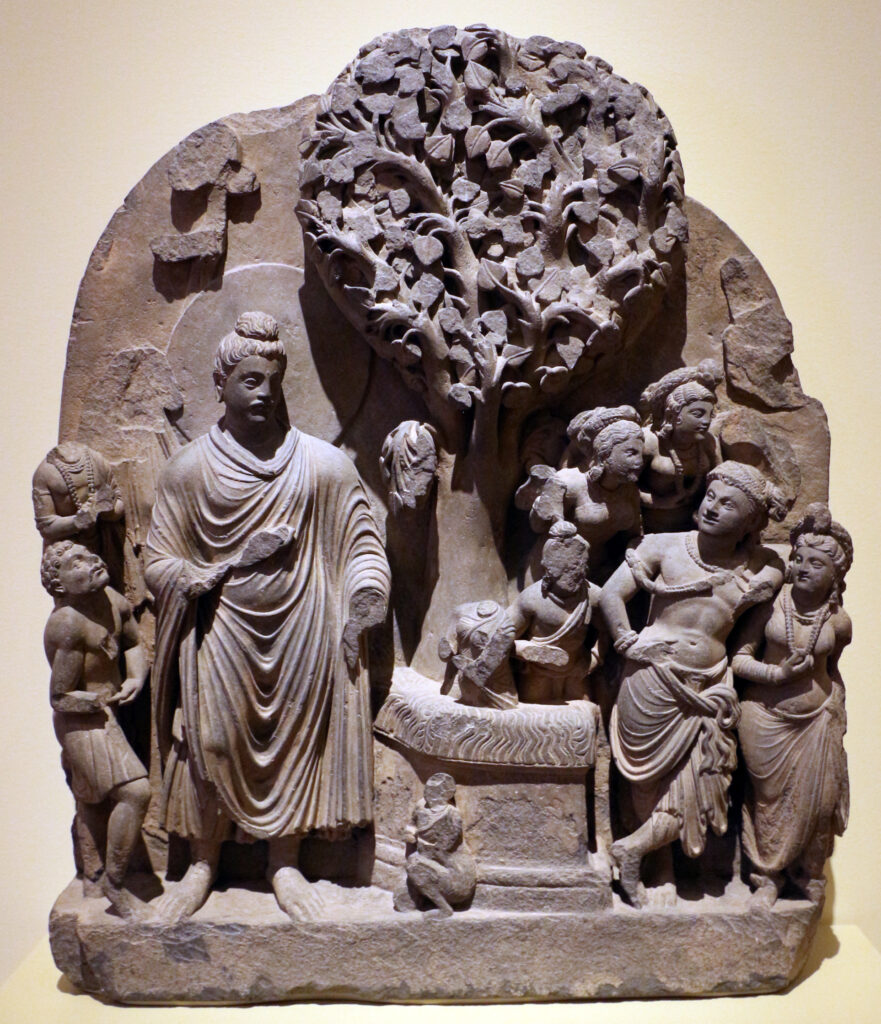
For this month’s Seasonal Sacred Art, let’s stand in front of one sculpture and listen to several feasts at once: a Gandharan relief of Siddhartha at the Bodhi Tree (1st–2nd century CE, today in the Cleveland Museum of Art), and around it the quiet, insistent glow of a Hanukkah lamp, an Advent wreath, and the candles of Bodhi Day. Different theologies, different calendars; but notice how often enlightenment, waiting and memory are painted with the same material: light in the dark.
The Bodhi Tree in Stone: Siddhartha in Gandhara
The Cleveland relief is modest in size but grand in intent. Carved in grey schist, it shows the Buddha just before he becomes the Buddha. At the centre, Siddhartha sits cross‑legged beneath the Bodhi tree, his body upright, his robe falling in calm, classical folds. The sculptor comes from Gandhara, a region where Greek, Iranian and South Asian currents met; you can feel it in the drapery that behaves like a Roman toga while the subject remains resolutely Indian.
The Bodhi tree rises behind him like a stone fountain of leaves. Its canopy is engraved in tight, rhythmic clusters, more pattern than botany, a reminder that this is not landscape but the place: the axis where, on Bodhi Day, Buddhists remember the night Siddhartha defeated Mara’s temptations and woke to full understanding. At the base of the tree, the earth goddess kneels, emerging from the ground, ready to witness his enlightenment when he calls the earth to bear witness with a touch of his hand.
Look more closely at Siddhartha’s face. The cheeks are gently rounded, the eyes half‑closed in the famous inward gaze, the lips caught between breath and mantra. This is not dramatic ecstasy; it is concentration made visible. The halo behind his head is shallow but firm, a stone nimbus of awareness. The whole composition reads like a cross‑section of the universe: heavens suggested above, the human seeker at the centre, the earth‑deity below. A vertical Advent calendar of sorts—only here the awaited one is awakening within himself.
If you’d like a framework for unpacking scenes like this, my guide How to Read a Painting (in 7 Steps) works just as well for sculpture: start with composition and light, then move toward gesture and symbol.
Bodhi Day: Lamps for the Sleepless Night
Bodhi Day, celebrated by many Buddhists on 8 December, commemorates this very night of “awakening under the tree.” In some temples, devotees string coloured lights through Bodhi leaves; in others, they keep a quiet vigil with candles, tea and sutra recitation. Our Gandharan relief gives that story an early visual form: the posture of immovability, the protective tree, the watching earth.
Notice how time behaves in the carving. The artist does not show the long hours of meditation, the three watches of the night that later tradition will enumerate. Instead, he folds the whole narrative into a single, crystalline now. The goddess is already there; the tree is already holy; Siddhartha is already haloed. Sacred art often cheats linear time like this. One moment stands in for many, the way a single candle flame stands in for the sleeplessness of an entire vigil.
To see how different painters handle that same compression of time on a flat surface, you might enjoy wandering through the Old Masters archive on this site, where saints, martyrs and philosophers are forever poised on the edge of decision.
Hanukkah Lamps: Memory in Eight Small Windows
While some Buddhists are lighting Bodhi lamps, Jewish families are bringing their hanukkiyot—Hanukkah lamps—out of cupboards and cupboards‑within‑cupboards. In late November and December, eight nights of Hanukkah recall the rededication of the Temple in Jerusalem and the miracle of oil that refused to run out.
Art history is quietly full of these lamps. In museum storerooms and online catalogues you can find 18th‑century brass Hanukkah lamps from Amsterdam, Italian silver examples bristling with architectural flourishes, and humble pewter versions from German towns. Many have a back‑plate pierced with a seven‑branched Temple menorah, lions of Judah, pomegranates, or a crown of Torah; below, a row of eight tiny oil fonts waits like a procession of doorways.
From a distance they look like small façades, but come closer and you see how tenderly human they are. Soot collects in the corners; wick‑holders lean a little; sometimes a past owner has scratched a name on the back. Hanukkah is about a national memory, yes—but these objects remind us it is also about light on a kitchen shelf, against winter glass, in the hour when the working day is done.
Light behaves differently here than under the Bodhi tree. There, illumination is inward: a mind clarified. In the Hanukkah lamp the miracle is duration: enough oil for a single night becomes light for eight. Yet both traditions choose a small, stubborn flame as their emblem. Both say: in a world that forgets, remember; in a season that darkens, keep watch.
Advent Wreaths and the Art of Waiting
And then there is Advent, which Western Christians begin in late November or early December. If Hanukkah stretches one miracle into eight and Bodhi Day compresses a long night into a single image, Advent stretches waiting over four Sundays. On many tables sits a circle of evergreen with four (sometimes five) candles: one more lit each week as Christmas approaches.
Unlike our Gandharan relief, the Advent wreath has no canonical museum form; it is a living, improvising tradition. But its logic is deeply visual. The circle of green stands for time and eternity, repeating and unbroken. The candles are tiny columns of event: hope, peace, joy, love—names vary by community, but the sequence of brightening is the same. It is minimalist sacred art, assembled in households rather than ateliers.
When painters take up the Advent mood, they often borrow older visual languages: the expectant Virgin in Annunciation scenes, a lone prophet with lamp or scroll, a winter landscape pierced by church windows. If you scroll through my earlier piece on David’s “Death of Socrates”, you’ll see how artists long before modern Advent wreaths were already using a single, disciplined light source to talk about readiness and resolve.
Across Traditions: Lamps, Leaves, and Vigil
Set these three together—Bodhi, Hanukkah, Advent—and you start to see a seasonal family resemblance. In each case, art rises to the same set of questions: How do you show hope before fulfilment? How do you carve or paint the night before?
- In our Gandharan relief, the answer is the tree: rooted, towering, sheltering, its foliage a stone aura of patience. Siddhartha is not yet the Buddha in narrative terms, but the sculptor wraps him in the signs of what will shortly be true.
- In the Hanukkah lamp, the answer is the row of unlit cups at the beginning of the feast: potential light, waiting for wick and blessing. By the eighth night, each little arch or spout remembers its turn.
- In Advent practice, the answer is the partially lit wreath, sitting on the same table week after week, asking gently: how far along are you now?
In all three, sacred art and ritual refuse instant illumination. They teach us to sit with the almost, the not‑yet, the “one more night”. If you’re curious about how artists use devices like repetition, symmetry and gesture to sustain that kind of tension, the Glossary of Art Techniques is a handy companion: look under entries like rhythm, axis, and symbol.
Where to See These Worlds
Siddhartha at the Bodhi Tree is on view at the Cleveland Museum of Art (India, Gandhara region, 100s–200s CE, schist; accession 1997.151). The museum’s collection is a quiet treasure‑house of cross‑cultural religious imagery. For a contrasting season, you could pair it with a Baroque altarpiece or a medieval Christian reliquary—many of which I discuss in the broader Art History category here.
Historic Hanukkah lamps gleam in vitrines from New York to Amsterdam; many are generously photographed in open‑access museum databases. Advent wreaths, on the other hand, you will mostly find off the record—on kitchen tables, in parish halls, in windows that briefly turn into little chapels at dusk. Bodhi trees, real and carved, appear everywhere from Indian miniature painting to Japanese temple gardens; the Cleveland relief is one early stone voice in a long grove of images.
Wherever you are on the map, this late‑autumn, early‑winter season is inviting you into a kind of global vigil. Some traditions wait for a child, some for enlightenment, some for deliverance, some simply for the courage to keep going. Art records those long nights with extraordinary tenderness: one cup of oil, one leaf, one halo, one flame.
Which festival image, lamp, tree, or icon would you love to see unpacked in a future Seasonal Sacred Art post?