
There’s a moment in high summer when the world smells of bread. Pieter Bruegel the Elder captured it in The Harvesters (1565), a panel from his famed seasons cycle. At first glance it’s a country lunch. Look longer, and it’s a symphony of labor, leisure, and light—one that quietly rewrote what a landscape painting could be.

Composition: a field that breathes
Bruegel seats us on a hillside, eye level with scythes and sheaves. The foreground crew cuts a bright, triangular wedge into the gold, while a cool, shaded group collapses beneath a pear tree to eat their thick slices of bread and cheese. That big diagonal—harvesters at work on the left, harvesters at rest on the right—acts like a hinge. Beyond it, the land unspools in stages: orchards, a village, far fields, and finally a watery band where ships nose along the coast. The space exhales. We move from the crunch of stubble underfoot to a breeze that slips in from the sea.
Color and light: wheat as a weather report
Bruegel’s palette is a harvest of its own: bread-crust browns, butter and straw, the green of resting shade, the blue of distance. He uses warm, matte passages for the sun-beaten field and cool, silvery notes where the eye can rest—look at the church tower on the horizon, the pale path snaking to the mill, the glint of water. The result is August you can feel on your skin: glare in the stubble, relief under leaves.
Details that tell on us
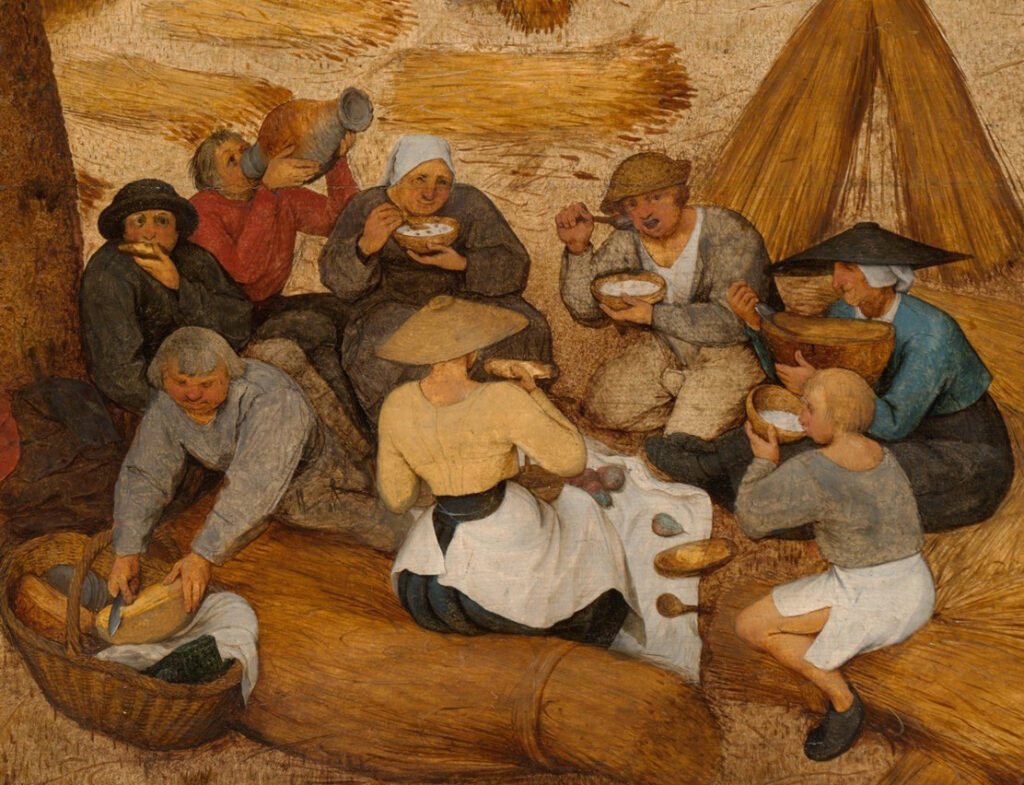
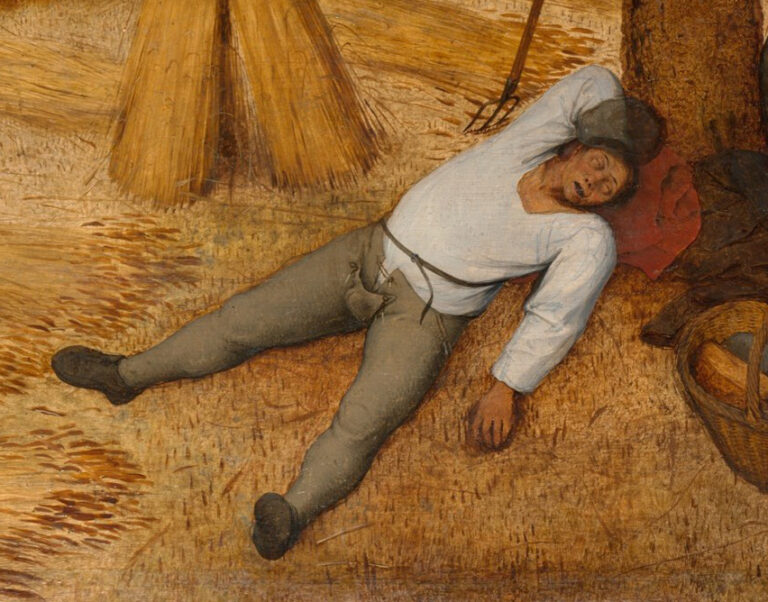
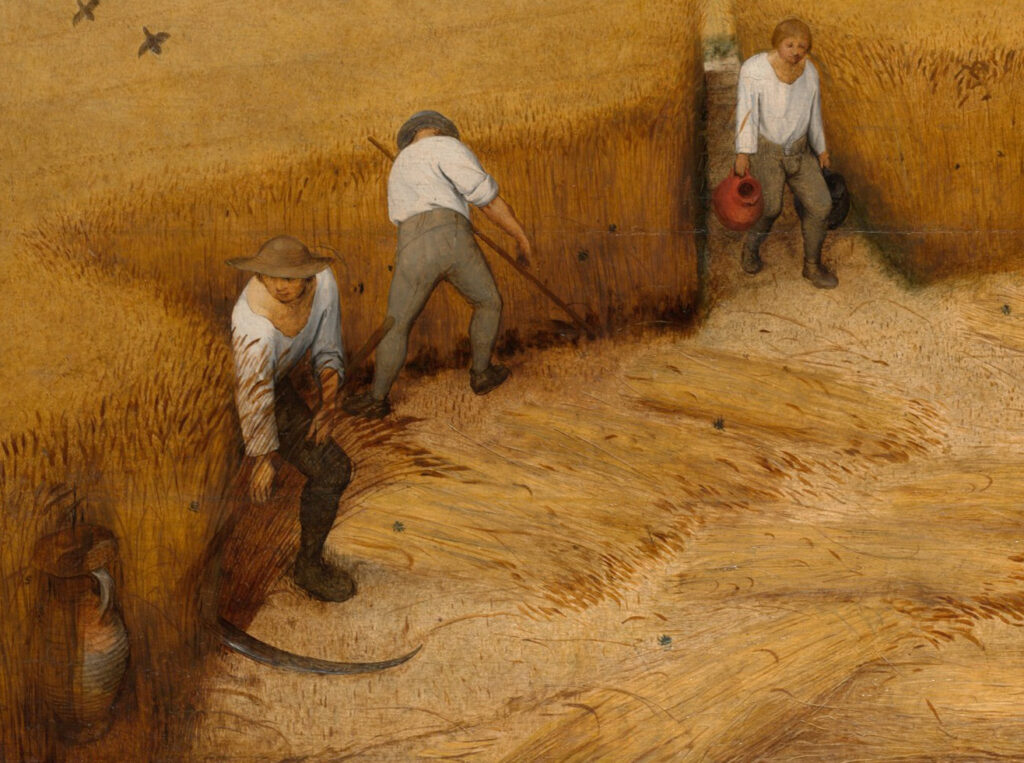
Bruegel’s jokes are gentle and human. A boy clambers up the pear tree; another naps so hard his hat slides off. One harvester stuffs pears into a hat turned into a basket. A scythe glitters along the edge of a sheaf like a warning. Follow the zig‑zag of activity and you’ll find a tavern game, a roadside shrine, and a couple stealing a kiss in the shade. Work and play lean on one another; the painting insists both are part of the same honest day.
Technique: choreography in broad daylight
Bruegel handles oil like a storyteller—broad planes for the land’s big rhythms, quick accented strokes for sheaves, stalks, and faces. The shifting scale (massive foreground figures tapering to pinprick laborers and toy ships) keeps our eye moving, measuring human effort against a world that is, kindly, bigger than we are. The horizon isn’t a barrier but a promise: more fields, more lives, more stories.
Meaning: a season made monumental
The Harvesters is part of a cycle commissioned by the Antwerp merchant Niclaes Jongelinck, each panel mapping the year’s mood. Bruegel gives August–September the dignity of history painting without the trumpets: ordinary people, centered, unhurried, necessary. In the 16th century, that was quietly radical. Today it reads like a love letter to the work that keeps a culture alive.
Where to see it: The painting lives at The Metropolitan Museum of Art, New York. If you visit, let your eye wander—Bruegel rewards patience with small miracles.
A tiny anecdote to pocket

Bruegel’s seasons series was dispersed long ago, but you can still “walk” the year: Hunters in the Snow and The Gloomy Day in Vienna, The Return of the Herd also there, and The Hay Harvest in Prague—then back to New York for this golden noon. The cycle becomes a calendar of looking.
Have a painting you’d love me to decode next? Drop your wish below—I’m listening.