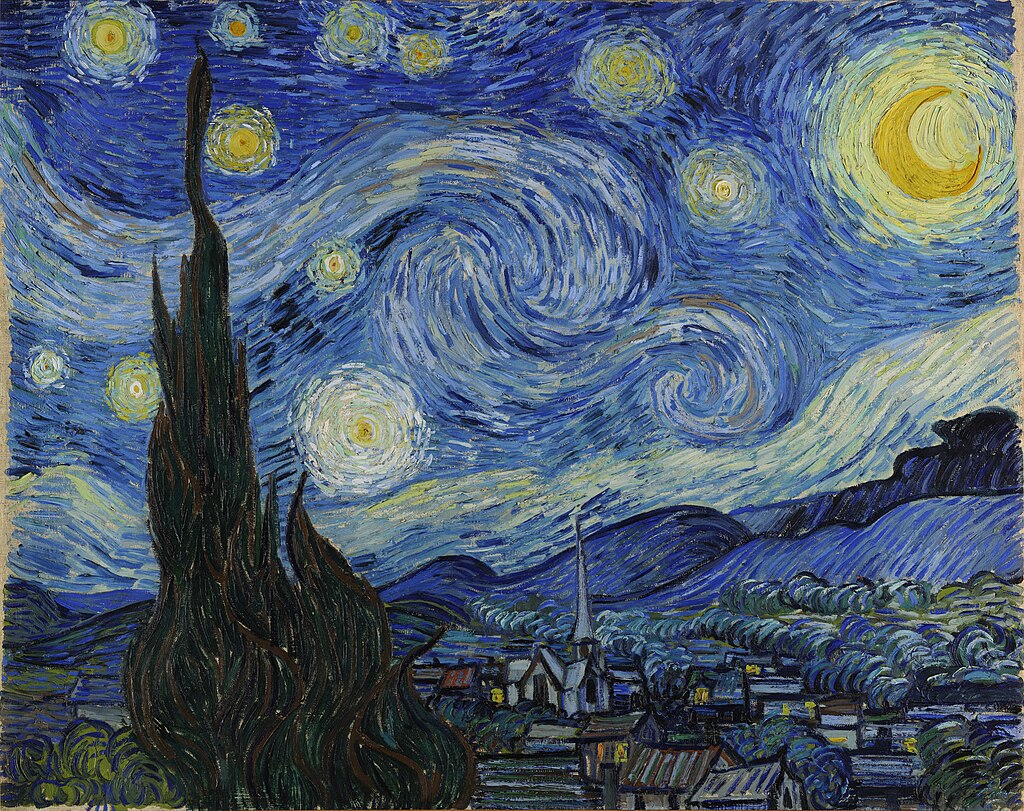
Some paintings don’t just show a night; they make it breathe. Van Gogh’s The Starry Night is one of those rare canvases where sky turns into music — a nocturne played in cobalt and chrome yellow.
First look: a sky that moves
The first thing your eye feels (before it even “sees”) is motion. The heavens coil into two great spirals, a kind of celestial handwriting. Each star hums with a halo; the moon swells like a golden bell. Van Gogh guides your glance along rhythmic curves that keep circling back, as if the universe were inhaling and exhaling above a sleeping village.
Composition: the quiet village and the tall cypress
Notice the duet: low, geometric houses and a slender church spire on the right; a tall, flame-dark cypress on the left. The cypress is the painting’s exclamation mark — a vertical counterpoint that stitches earth to sky. Its silhouette echoes the church spire but with wilder energy, as if memory (Van Gogh’s Dutch churches) had been transplanted into the Mediterranean night of Saint‑Rémy.
The village is calm, almost invented — rectangles and roofs arranged to rest your eyes after the sky’s swirl. That balance is intentional: turbulence above, tenderness below. The diagonal of the hills gently lifts us into the vortex, while the cypress anchors us so we don’t float away.
Color and brushwork: sound you can see
Van Gogh’s blues are a chorus: deep ultramarine shaded by calmer cobalt, then shocked awake by rings of yellow and white. He lays paint thickly (impasto), so the starlight isn’t merely depicted — it’s built. Directional strokes flow like currents; if you trace them with a finger, you can almost feel the wind. The moon’s yellow plays against the surrounding blue — classic complementary contrast — making the night feel electric rather than dim.
Symbols (and a few delicious rumors)
The cypress often stands for life, death, and the passage between — fitting for a tree that reaches up like a wick into the cosmic flame. The brightest “star” at left is often identified as Venus, which really did shine in the Provence sky when Van Gogh painted this in 1889. And that blackish‑blue background? It’s not emptiness; it’s layered with glazes so the sky reads as deep space with weather.
We should also remember: this is not a window snapshot. The village is stylized, the sky is felt rather than recorded. Van Gogh sometimes worried he had pushed emotion too far; we’re lucky he did. His exaggeration is the point — intensity polished into poetry.
A small detail to love
Look closely at the stars’ halos and the moon’s shimmering edge. They aren’t blended into soft fog; they’re rings, like ripples when a stone hits water. It’s a simple, brilliant decision: light as vibration. Once you see it, you’ll spot the rhythm everywhere in the picture.
Where to see it
The Starry Night lives at the Museum of Modern Art (MoMA) in New York. If you visit, step closer to let the paint catch the light, then step back to let the motion carry you. Two distances, two different symphonies.
Why it endures? Because it gives us a night that isn’t cold or empty. It’s a night that reaches out — and breathes back.