
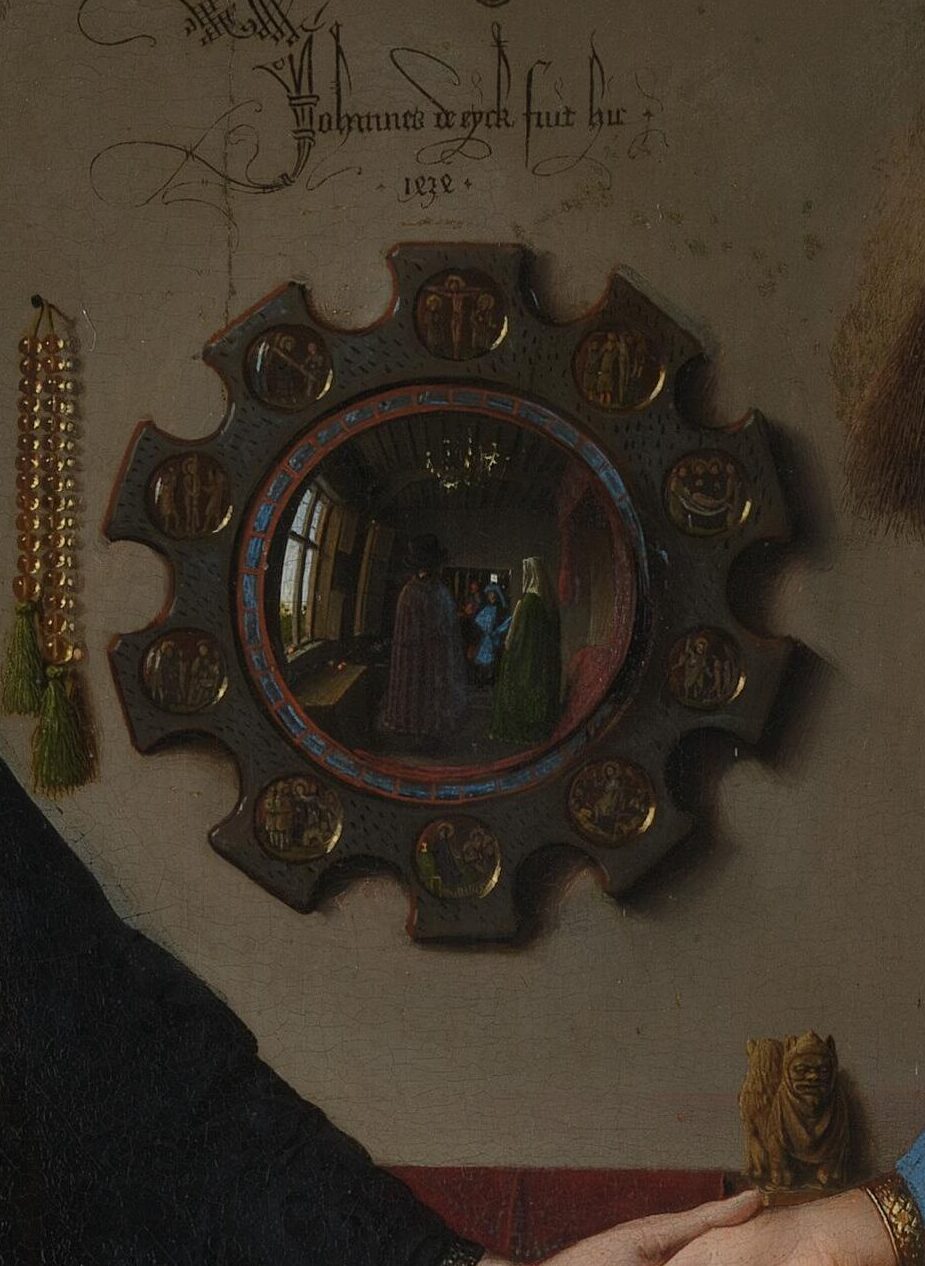
For this week’s Looking Closer, we step into one of art history’s most famous circles: the tiny convex mirror at the center of Jan van Eyck’s Arnolfini Portrait (1434), today in the National Gallery, London.

The mirror is scarcely bigger than a coin, yet it behaves like a second painting. Its glassy eye curves outward, swallowing the entire room. The couple we see from behind in the main panel reappear frontally in the reflection, joined by two extra figures at the doorway—one likely the artist himself. It’s as if the painting turns around and looks back at us.
Look closely at the frame around the mirror: ten tiny medallions narrate scenes from the Passion of Christ. Van Eyck paints them at a scale where most mortals would give up and reach for a magnifying glass. Yet each oval has legible poses, halos, even a whisper of landscape. Devotion quite literally surrounds self-image.
Technically, the mirror is a tour de force of oil painting. See how the highlights pool along the rim and flare at the center, suggesting both the curve of the glass and the light from the window. The bluish cast of the reflection cools the warm browns and greens of the room, a reminder that mirrors do not simply copy—they translate.
Symbolically, that shimmering circle becomes a moral device. It witnesses the scene (note the inscription above: “Jan van Eyck was here, 1434”) and hints that any vow—spousal, social, or spiritual—is made under watching eyes, human and divine. To read this one detail is to feel how Northern Renaissance artists turned optics into ethics.
Want to train your eye on other tiny miracles of paint? Stroll through How to Read a Painting (in 7 Steps), dip into the Glossary of Art Techniques, or visit Open-Access Museums: Where to Find Free, Legal Images. And if you enjoyed van Eyck’s visual games, you might like my earlier deep dives into Vermeer’s glowing bread or Rembrandt’s troublesome gold chain.
Which microscopic corner of a painting should we zoom into next Friday?