
Paris, around 1860. In a cramped studio, a young Édouard Manet asks a model to sit not as a mythological goddess or noble lady, but as something far more alarming to the Parisian Salon: a street musician. The man settles with his guitar, costume slightly theatrical, fingers hovering over the strings. Manet begins The Spanish Singer.
Spain is wildly fashionable in Second Empire Paris—bullfights, boleros, Goya—but Manet is after something more than exotic flavour. He paints the singer close to us, almost life‑size, the guitar pushed forward like a second voice. Look at the rough bravura of the brushwork on the jacket, the way the white shirt is slashed in with thick, bright strokes. It feels less like careful description, more like music played fast and a little too loud.
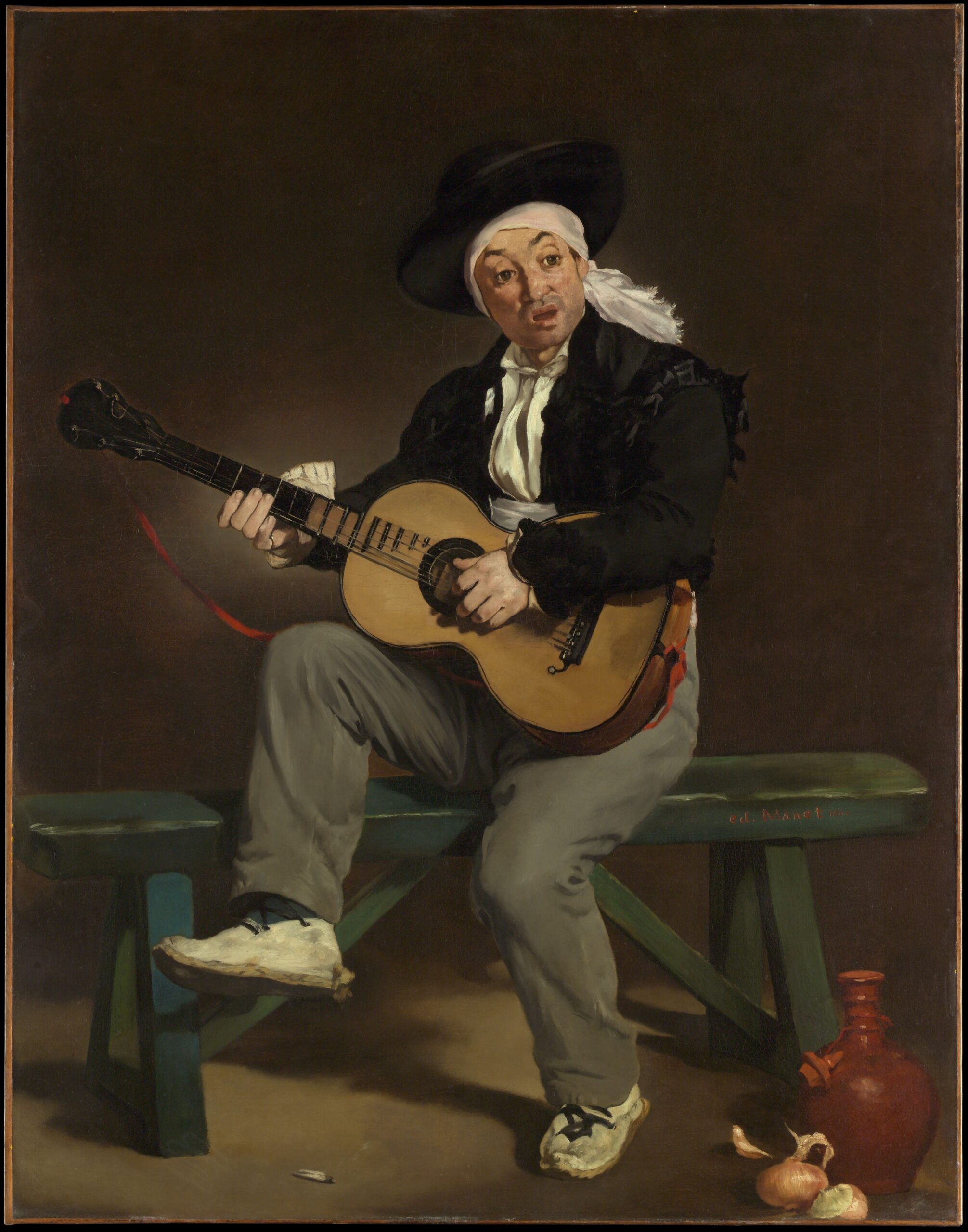
When Manet sends the painting to the Salon of 1861, critics are divided. Some complain about the visible brushstrokes and “unfinished” look; others sense something electric. A young poet named Charles Baudelaire and a still‑unknown painter called Claude Monet take note. This Spanish guitarist, half‑actor, half‑ordinary man, is one of the first signs that Paris has a new kind of painter: one willing to sacrifice polish for presence.
If you’d like to train your eye on Manet’s bold surfaces, my guide How to Read a Painting (in 7 Steps) is a calm companion. For terms like impasto, alla prima, and genre scene, browse the Glossary of Art Techniques. You can also explore more Manet and his friends through open images via our Open‑Access Museums guide.
Manet’s Spanish singer never actually sings for us, of course—but once you’ve met his gaze, it’s hard not to hear Paris modernity clearing its throat.