
Oslofjord air has a particular chill to it—salt, tar, and the faint metallic scent of cold water. In 1879, a young Norwegian painter named Christian Krohg stands on a dock, watching a woman mend fishing nets. She is not posed, not aware of him as a “subject”. She is simply working, fingers moving with the automatic intelligence of habit.
From this quietly stubborn scene he will paint The Net Mender (Garnbinderen). No pearls, no silk, no mythological props. Just a woman in a simple dress, hands in her lap, the web of nets spilling around her like a rough, practical veil.
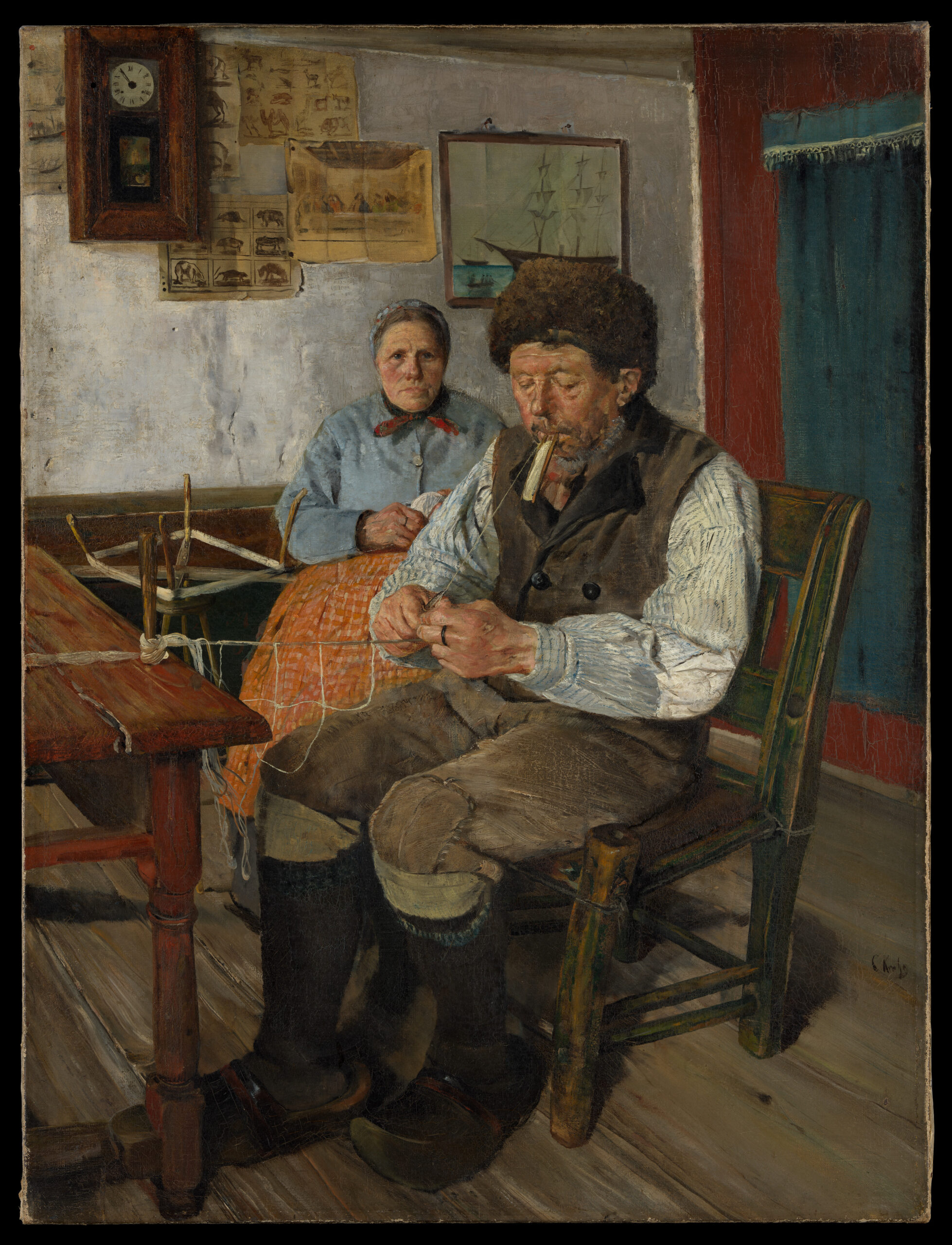
Krohg belongs to a generation of Scandinavian painters steeped in realism—determined to paint the lives actually led along the coasts and city streets. His mentors admired French painters like Courbet and Manet; they brought back the idea that fishermen, seamstresses, and sleepy dockworkers were as worthy of the canvas as any king.
Look at the woman’s face: not idealised, not sentimental. Her gaze slides past us, turned toward some private thought or simple tiredness. The colour range is sober—blues, browns, weathered whites—yet the light on her cheek and hands gives her a quiet dignity. She is not a symbol of “the people”; she is simply herself, and that, in 1879, is already a small revolution.
If you’d like to train your eye on such seemingly modest scenes, stroll through How to Read a Painting (in 7 Steps), then browse related techniques like impasto and glazing in the Glossary of Art Techniques, and hunt for more Krohg and his contemporaries via our Open‑Access Museums guide. For another life lived close to working docks and rough crowds, wander next to Toulouse‑Lautrec, the Broken Legs, and the Moulin Rouge.
Christian Krohg reminds us that sometimes the most radical thing a painter can do is simply to sit down by the water and look, really look, at the work-worn hands in front of him.